UFC Betting UK: Best Fight Odds and Bookmakers
 Available in US
Table of Contents
- UK UFC Betting Markets and Bookmaker Odds
- What This Guide Settles In One Minute
- The Legal Frame: UKGC, Age And What Offshore Actually Costs You
- Reading A UFC Line The Way British Bookmakers Print It
- The Markets You Will See On A UFC Card
- Picking A UFC Bookmaker Without Falling For The Front Page
- Turning Fight Statistics Into A Reading Of The Card
- UFC In Britain: London, Manchester And The Rhythm Of The Calendar
- Live Betting, Cashout And Bet Builder On UFC
- Integrity Risks In MMA Betting And What They Mean For You
- The Ten-Minute Routine Before You Confirm A Bet
- The Habits That Keep UK UFC Bettors In The Game
- Questions UK Readers Send In Most Often
UK UFC Betting Markets and Bookmaker Odds
My Saturday Fight Night routine has not changed much in nine years. I open the UKGC operators around 10am, sketch the lines into a notebook, then watch the open workout clips from the previous Tuesday with the sound off. Most of what shifts a price in a UFC fight is movement, not narrative, and that habit is the reason I learned to bet on UFC fights with a head rather than a mood. If you take only one thing from this guide, take that.
British bettors face a market that does not quite match the American or European one they read about elsewhere. UKGC oversight, fractional odds as the default display, the bet builder and cashout buttons sitting beside every fight — these are UK norms, not universal ones. A guide written for Las Vegas reads strangely once you are looking at a Coral or Betway slip with 5/2 next to a featherweight name. That mismatch is the reason so many curious newcomers drift to offshore sites where everything looks familiar and absolutely nothing protects them.
A few headline numbers set the scale. UK gross gambling yield reached £16.8bn for the year to March 2025, up 7.3% year on year. UFC the company posted a record $1.406bn in revenue across 2024, with media rights making up 62.5% of that. Britain is the third-largest country for traffic to ufc.com, behind only the United States and Canada at 6.84%. This is a serious market, in money and in attention. What follows is the working knowledge I would hand any British friend who wanted to start placing UFC bets seriously, in the order I think you should learn it.

Moneyline — the simplest UFC market: a straight price on who wins. In Britain it shows up as a fraction (5/2) rather than the American minus-and-plus shorthand.
Pick’em — a fight the bookmaker rates as roughly even. You will see prices like 10/11 on both sides, with the small dip below evens covering the operator’s margin.
What This Guide Settles In One Minute
- UFC betting in the UK is legal only through operators holding a UK Gambling Commission licence; everything offshore strips you of dispute, deposit and self-exclusion protection.
- Fractional odds are the default display, but every UK board flips to decimal in a single tap — both formats describe the same price.
- Five markets do roughly 95% of the action: moneyline, method of victory, round betting, props and parlays. Build literacy in that order.
- Favourites win 65–70% of UFC fights on a ten-year sample, but the edge sits in divisional finish rates — heavyweight ends in a knockout half the time, flyweight goes to the judges in more than half.
- The pre-bet routine is non-negotiable: licence check, bankroll fixed in advance, fight studied, deposit limits set.
The Legal Frame: UKGC, Age And What Offshore Actually Costs You
About once a month someone messages me asking whether a flashier site, the one with the louder welcome offer and no GamStop button, is actually fine to use because “they take British pounds.” It is not fine. The pounds going to that site are not protected by anyone you can call on a Monday morning. That is the whole game when it comes to the legal frame, and it deserves to sit at the top of any UK UFC guide.
You can bet on UFC fights from the UK only through a bookmaker holding a UK Gambling Commission licence. The minimum age is 18, no exceptions, and the operator must verify it before accepting a deposit. The licence carries real obligations: segregated client funds, GamStop integration, deposit limits, mandatory affordability checks above certain thresholds, and a dispute pathway that ends with the Commission rather than the operator’s own customer-service queue. None of that exists offshore.
Quick UKGC check — every legitimate operator displays its licence number in the website footer. You can paste that number into the Commission’s public register to confirm it is current and lists the right trading name. If the footer is missing, vague, or the number returns no result, you are not on a licensed site.
The scale of the parallel market is the part most guides skip. UK players staked an estimated £16.6bn on offshore, unlicensed sites in 2025, up from roughly £5bn six years earlier. The share of UK bets placed legally has fallen from 97% in 2019 to 92% in 2025, and the trend line is not flattening. That is real money moving outside any consumer-protection framework, and a sizable chunk of it is on combat sports because MMA props travel well across borders.
Andrew Rhodes, the Commission’s chief executive, framed the legal market’s scale in his February 2025 speech to the industry: “Recent data published shows that total gross gambling yield is at its highest ever level at £15.6bn. Participation in gambling has remained stable at 48%, just under half of the adult population in Great Britain.” That is the population the regulator is trying to keep inside the gates. Once you are outside them on a UFC bet, nobody is keeping anything for you.
Responsible play is part of the legal frame, not a footnote. Set a deposit limit before your first stake, use the cooling-off and time-out tools every UKGC operator must offer, and if your relationship with the activity changes, GamStop can self-exclude you from every licensed UK site in one registration. For deeper coverage of the regulatory side, see my UK UFC betting regulation breakdown.
Reading A UFC Line The Way British Bookmakers Print It
The single most common conversation I have with a new bettor goes like this: they point at a number such as 2/5 and ask me whether that is the favourite or the underdog. Half of them guess wrong. The fraction looks deceptively casual, like the kind of thing you would see in a recipe, but it carries everything you need to know about price, probability and the bookmaker’s cut. Once it clicks, it stays clicked for life.
British operators print UFC prices as fractions by default. The reading rule is simple. The first number is what you win if the second number is your stake. So 5/2 means you win £5 for every £2 risked; a £10 stake returns £25 in profit plus your £10 back, for a total return of £35. 2/5 is the other way around: you win £2 for every £5 risked. A £10 stake returns £4 profit plus your tenner, total £14. Same digits, opposite roles. The shorter the right-hand number, the heavier the favourite.
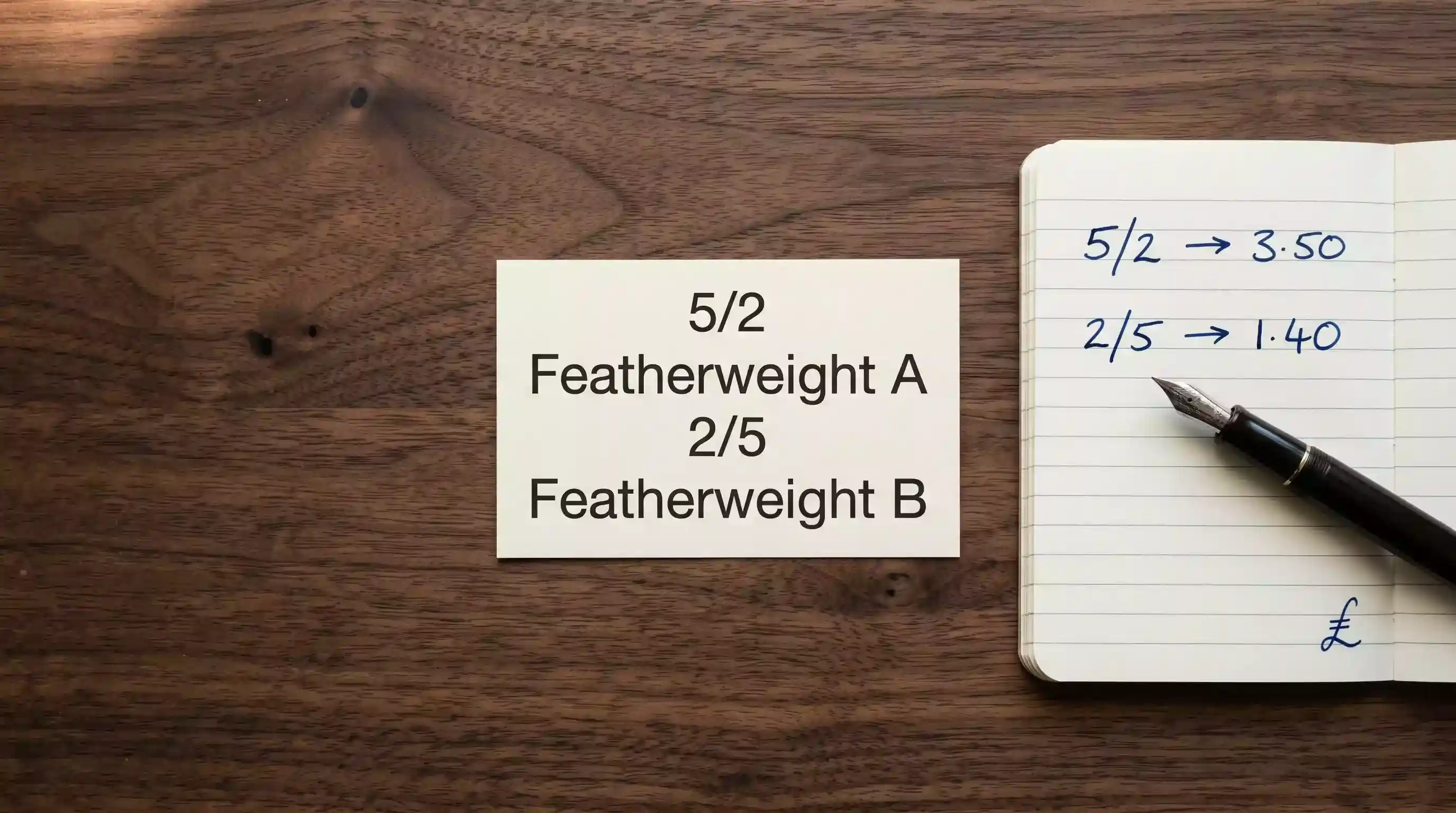
Worked example: 5/2 underdog and 2/5 favourite on the same line
A featherweight fight prices the favourite at 2/5 and the underdog at 5/2. A £25 stake on the favourite returns £35 (£10 profit + £25 stake). The same £25 on the underdog returns £87.50 (£62.50 profit + £25 stake). The market expects the favourite to win comfortably more than half the time, and the prices are arranged so that backing both sides loses you money — that loss is the operator’s margin.
Decimal odds are the same numbers in a different jacket. Every UK board has a toggle in the settings, usually one tap, that converts the entire slip. 5/2 becomes 3.50. 2/5 becomes 1.40. 11/10 becomes 2.10. Evens, or “Evs”, which is the British shorthand for 1/1, becomes 2.00. The decimal reading rule is even simpler: multiply your stake by the number and that is your total return including stake. A £10 stake at 3.50 returns £35. Pick whichever format your eyes prefer and stick with it.
Chalk — slang for the favourite. A “chalky” card is one where every fight has a clear favourite priced at short odds. Originally from the chalkboards bookmakers used at racecourses.
Dog — short for underdog, the longer-priced side. A “live dog” is an underdog with a real path to winning, not just a name to fill the other side of the board.
The probability layer is where most bettors stop reading and the sharper ones lean in. Every fractional price implies a probability that the bookmaker assigns to that outcome. For 5/2, the implied probability is 2 divided by (5+2), which is 28.6%. For 2/5, it is 5 divided by (5+2), which is 71.4%. Add those together and you get exactly 100% — but only because I picked clean numbers. In a real UFC market the two implied probabilities sum to something like 104% to 108%. The extra few points are the operator’s margin, sometimes called the overround. Your job is to find fights where you think the true probability is meaningfully higher than the implied one, and pass on everything else.
One reason favourites are not automatic value: across UFC’s ten-year history, favourites win roughly 65–70% of bouts. That is a high number, but the moneyline price often demands an implied probability above 75% just to break even after the overround. Backing every favourite is a slow leak. The market knows it is the favourite too.
For deeper coverage of conversion, implied probability and how lines move between open and walk-in, see my full UFC odds reading manual. The aim there is to build the same muscle memory I built in my first two years: glance at a line, know the probability, know the overround, decide in seconds.
The Markets You Will See On A UFC Card
A regulation Fight Night card ships with forty to a hundred individual markets depending on the operator. That can feel like a wall, but the structure is friendlier than the surface suggests. Five families do most of the action, and the rest are variations. Treat the sub-sections below in the order they appear — that is the order I would learn them in.

| Market family | Typical odds range | Operator margin | Risk profile |
|---|---|---|---|
| Moneyline | 1/4 to 7/1 | Low to moderate | Lowest variance |
| Method of victory | 2/1 to 10/1 | Higher | Moderate variance |
| Round betting | 3/1 to 25/1 | Higher | High variance |
| Over/under rounds | 4/6 to 7/4 | Moderate | Moderate variance |
| Prop bets | 6/4 to 33/1 | Highest | Highly variable |
| Parlays / accumulators | Compounded | Compounded | Highest variance |
| Bet builder | Compounded with correlation | High | Highly variable |
Moneyline
Pick the winner. Nothing else. This is the spine of UFC betting and the only market I would let a beginner touch in their first month. Prices range from heavy favourites at 1/4 down to live underdogs at 5/1 or further on the right cards. The whole skill is calibrating your sense of probability against the operator’s. If you cannot beat the moneyline over a hundred bets, no other market will save you.
Method Of Victory
Method of victory — a market that pays only if your fighter wins by a specific route: KO/TKO, submission, or decision. Each side of the moneyline is split into three sub-bets.
About 53% of all UFC fights end inside the distance: 33.3% by KO/TKO, 19.7% by submission, the rest by judges. The divisional split is where price errors live. Method of victory carries a fatter margin than moneyline because it bundles two predictions into one, and casual money piles onto the obvious KO sides. The opportunity is on the unloved routes: decision wins for a striker who tends to grind, submission wins for a wrestler who has quietly added a guillotine to their game.
Round Betting And Over/Under Rounds
Round betting asks which specific round the fight ends in. Over/under rounds asks whether the fight clears a half-round threshold, most often 1.5 or 2.5. The two markets cover the same ground from different angles. Roughly 41% of UFC men’s bouts end before the 2.5-round line, which gives the under side a baseline pull on most cards. Five-round main events shift the maths and reset the lines, so check whether you are looking at a three-round or five-round bout before you price the over.
Prop Bets
Props are the side menu: total significant strikes, knockdowns scored, takedowns landed, fight to go the distance, will the post-fight interview include a callout. Some are sharp markets backed by deep data; others are essentially novelty plays the operator has thrown up to fill a page. I keep my prop exposure under 10% of any night’s bankroll. The variance is too high to live on, but the targeted single prop is occasionally the cleanest value on the board.
Parlays And Accumulators
An accumulator combines several selections into one slip — every leg has to land for the bet to pay. The maths is brutal and the marketing is loud. A four-leg accumulator at evens on each leg pays roughly 15/1 but has a true probability around 6%. If you treat them as entertainment they are fine. If you treat them as a strategy you will go broke.
Bet Builder
The bet builder is a parlay assembled inside a single fight. You combine, for example, Fighter A to win plus over 1.5 rounds plus over 75 total strikes. The selections are correlated, so the operator prices the bundle by hand rather than multiplying naively. Bet builder is genuinely the UK’s signature MMA innovation — bet365 popularised it for UFC, and most major UKGC operators now offer their own version. Used selectively on fights you have actually studied, it is a useful way to express a precise read.
In-Play Betting
Live markets open in the gaps between rounds and sometimes through the round itself on a delayed feed. The danger is impulse. The opportunity is the bookmaker’s slower reaction to obvious in-cage shifts. I will cover this in depth in the live-tools section below.
For market-by-market structure, suggested first stakes and the operator-specific quirks I have not had room for here, see my full breakdown of UFC bet types in the UK.
Picking A UFC Bookmaker Without Falling For The Front Page
The first UFC bookmaker I ever used was chosen because a friend at university had a referral link and the welcome page had a cage on it. That is not a system. That is a vibe. The actual decision should be made on a much shorter list of things, almost none of which appear in the operator’s marketing.
The biggest UFC partnership news in the UK orbit during recent months was bet365 being announced as the official sports betting partner of UFC in the US and Canada in March 2026, with deep odds integrations being built into the broadcasts. Nicholas Smith, TKO Group’s senior vice president for global partnerships, framed the logic on the day: “bet365 brings scale, credibility, and innovation to the sports betting space, and we’re thrilled to continue to develop this long-term partnership at such a momentous time for UFC.” The deal does not change UK regulation, but it does signal where the largest operators are putting their UFC engineering budgets — and where the better in-play products will live a year from now.
Seven checks before you open an account
- UKGC licence number visible in the footer and verifiable in the Commission’s public register.
- GamStop integration confirmed — every licensed UK operator must honour it.
- Odds-format toggle present, so you can switch between fractional and decimal in one tap.
- MMA bet builder offered for UFC fights, with at least the major legs available (winner, method, rounds).
- In-play UFC coverage during Fight Night main cards, not just numbered pay-per-view events.
- Cashout available on UFC singles and accumulators, with the partial-cashout option for stake management.
- Deposit-limit and time-out controls set during sign-up, before your first deposit clears.
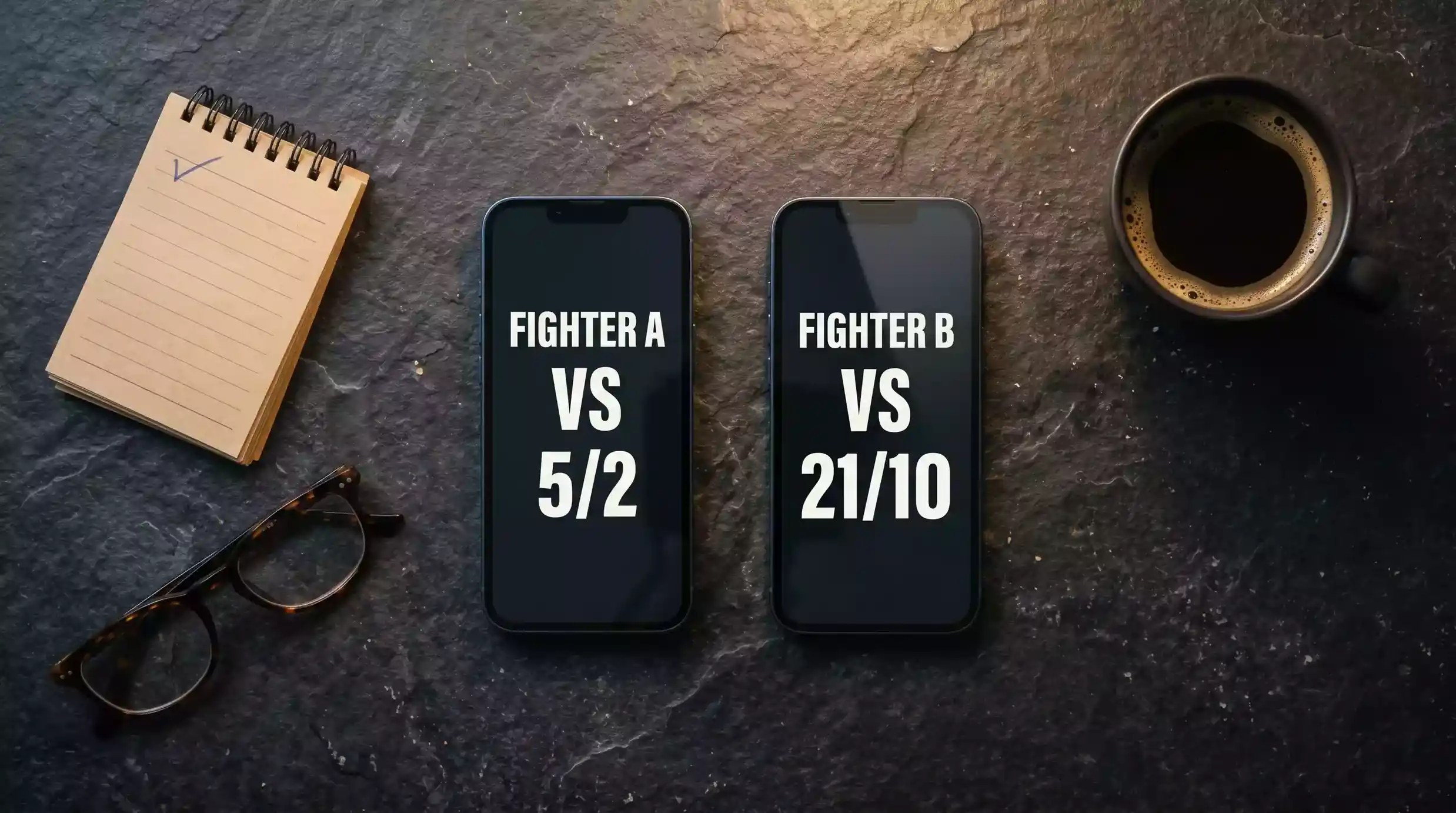
The instinct to choose by welcome offer is the wrong instinct. Welcome offers are designed to lock you into a single operator until you have wagered enough to forget why you started. The better mental model: open accounts at two or three UKGC-licensed sites, keep modest balances on each, and shop the price on every fight you intend to back. A 1/4-point edge on a 5/2 line — say one operator at 5/2 and another at 21/10 — moves the long-run maths meaningfully. You will not find that difference if you only ever see one screen.
A few operator features I think are genuinely worth weighting. Bet builder depth: how many legs the site allows inside one fight and whether method is bundleable with rounds. Prop coverage on Fight Night cards as opposed to only numbered events — many operators offer thin prop lists for lower-profile shows, which is precisely when prop value tends to live. Speed of in-play settlement after a finish — slow settlement at 11pm on a Saturday is the operator quietly telling you its UFC desk is understaffed. And the responsible-gambling toolkit. Mandatory deposit-limit prompts, reality checks, GamStop hooks and clear self-exclusion paths are signs of an operator that treats the UKGC framework seriously rather than as paperwork.
For a fuller framework, including criteria I left out of this overview, see my UK UFC betting site selection guide.
Turning Fight Statistics Into A Reading Of The Card
The first time a heavyweight knockout cashed a ticket I held for the wrong reason, I learned something useful: the cage does not care about your read, only the numbers behind it. Statistics will not tell you who wins on Saturday. They will tell you which markets to fish in, and they will quietly correct your gut over a few hundred bets.
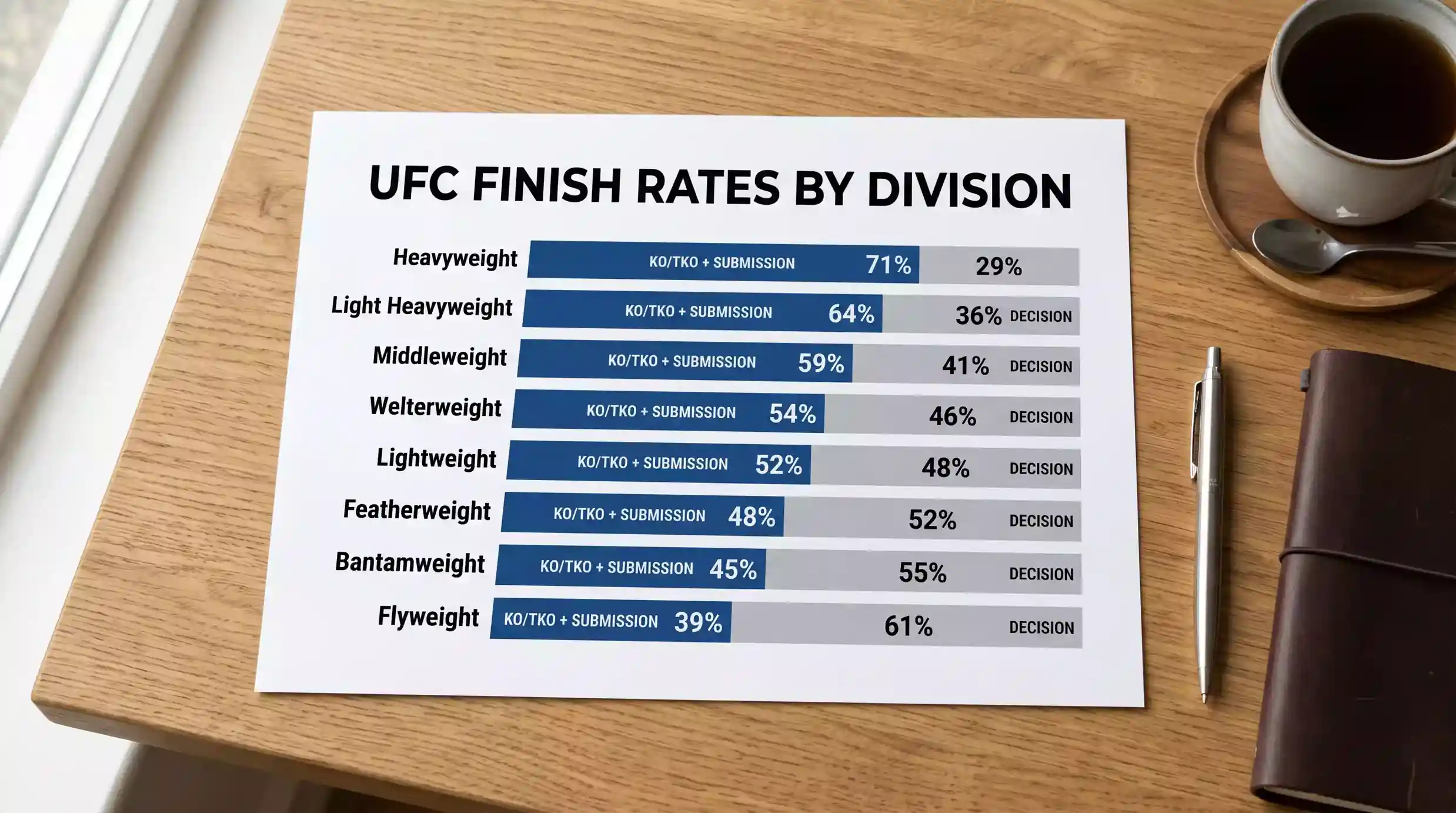
Finish Rates By Division
About 53% of UFC fights end inside the distance — split 33.3% KO/TKO and 19.7% submission, the rest going to the cards. That global number is the headline, but the divisional spread is where actual money is made. Heavyweight is its own world: roughly 50% of fights end in a knockout or TKO, and the decision rate is only 28.6%, the lowest in the entire promotion. Flyweight is the inverse: 24.6% KO, 21.7% submission, and roughly 53% of bouts go to the judges, the highest decision rate in any men’s division.
Heavyweight UFC fights end in a knockout or TKO half the time. That is roughly double the rate of the lightest men’s division. If a stylistically competitive flyweight fight is priced like a probable finish, the operator is asking the wrong question of its model.
What you do with this: when you see a flyweight pick’em offered at 5/6 on “fight to go the distance,” you remember that the divisional baseline is 53% decisions, the implied probability of 5/6 is 54.5%, and the operator has effectively offered you base rate with a thin margin. That is not a screaming value but it is reasonable exposure. The same line on a heavyweight fight is a trap.
Favourite Versus Underdog Patterns
Favourites win 65–70% of UFC fights across a ten-year window. The number is durable; what fluctuates is the price you have to pay. A favourite at 1/3 implies 75% probability — already above the long-run average. The edge sits in identifying which favourites are priced beyond their historical baseline.
The divisional cuts are where the interesting reading lives. In men’s flyweight since 2020, favourites have won 77% of bouts, the highest rate in the promotion. The mechanical hypothesis: lighter fighters have less knockout power, more grappling depth and longer fights, which gives skill differentials room to manifest. Heavy favourites — the heavily lopsided lines, not slight ones — push that figure to roughly 80% across the wider sample. The lesson is not “always back heavy favourites.” It is “the price ceiling for genuine flyweight chalk is higher than the cross-division average suggests.”
| Division | KO/TKO rate | Submission rate | Decision rate | Favourite winrate (recent) |
|---|---|---|---|---|
| Heavyweight | ~50% | Low | 28.6% | Mid-60s% |
| Light heavyweight | High | Moderate | ~35% | Mid-60s% |
| Middleweight | Moderate | Moderate | ~40% | ~70% |
| Welterweight | Moderate | Moderate | ~45% | ~70% |
| Lightweight | Moderate | Moderate | ~45% | ~70% |
| Featherweight | Lower | Higher | ~50% | ~70% |
| Bantamweight | Lower | Higher | ~50% | ~72% |
| Flyweight | 24.6% | 21.7% | ~53% | 77% |
Two more patterns worth keeping in your head. In rematches, the winner of the original goes 52-26 across the historical sample, a 66% repeat rate. The market often shortens the original loser as the “improved” version, but the base rate is stubborn. Of the nineteen underdog champions in UFC history, twelve successfully defended their title. The longer-priced new champion is not automatically paper; fading them blind in their first title defence is a losing strategy on the data.
Recent Form And Tape Study
Numbers without tape can mislead. A welterweight who has finished his last three opponents in the first round looks like a frightening favourite on the screen; the tape will sometimes show that those three opponents fought him with the same orthodox stance and the same defensive lapse, and his next opponent is southpaw with a calmer guard. Conversely, a fighter coming off two decision losses might look cold on paper but be 30 seconds away from winning each of them. I treat statistical signals as the prior and the tape as the update.
For the underlying tables, the divisional finish-rate matrix and the specific tape-study workflow I use during my Tuesday-night prep, see my deep dive on UFC fight statistics for betting.
UFC In Britain: London, Manchester And The Rhythm Of The Calendar
I have stood inside the O2 on more UFC London nights than I can comfortably count, and the noise on a home-fighter walkout still resets my pulse. That energy is not just atmosphere. It is the reason UK Fight Nights now command the kind of betting handle the promotion historically reserved for numbered events. Britain has quietly become one of the most active UFC markets in the world, and any UK bettor benefits from knowing the calendar’s rhythm.

The numbers behind the noise are striking. UFC London on 22 March 2025, headlined by Edwards versus Brady, drew 18,583 attendees and a gate of $4,711,410 — at the time the highest-grossing Fight Night in the promotion’s history. Twelve months later, UFC London on 21 March 2026, headlined by Evloev versus Murphy, pushed attendance to 18,629 with a gate of $4,520,137. The records keep moving and the city keeps absorbing them.
UFC London 2025 (Edwards vs Brady) sold out at 18,583 — the highest-grossing Fight Night card in UFC history at the time. UFC London 2026 (Evloev vs Murphy) edged it again on attendance the following March.
Dana White summed up the appeal of the city in his December 2025 announcement of the 2026 London card: “London is one of the premier fight cities in the world. The fans are passionate, the energy is incredible and the last time we were there we broke the highest-grossing Fight Night record in UFC history.” Lerone Murphy, the Manchester featherweight who headlined that 2026 card, told The Independent during the build-up to UFC 319 that his perfect scenario ran through Manchester: “I’ll tell you how my perfect scenario would be: I win this fight, I challenge Volk in maybe October or November, I win, obviously, and then I defend it in Manchester.” Whether or not the booking lands, the point is that British fighters openly chase home cards as career milestones, which keeps the UK calendar dense.
UK broadcast in 2026 — UFC’s UK broadcast partner is TNT Sports, with Paramount+ holding the global Numbered Events and selected Fight Nights through the recently signed seven-year deal worth $7.7bn. The arrangement covers 13 Numbered Events and 30 Fight Nights across the year. Watching the broadcast is its own informational edge: live announcer reactions, weight-cut visuals at the morning weigh-ins and open workout footage from the Wednesday before fight night all shape the late line moves.
The traffic data confirms the depth of the UK appetite. Britain is the third-largest market by traffic to ufc.com at 6.84% of total visits, behind only the United States at 31.95% and Canada at 7.53%. That is a serious slice of the global fanbase concentrated on an island of 67 million people, and it explains why operators are willing to keep dense, well-priced markets open on every UK Fight Night.
The structural difference between Numbered Events and Fight Nights matters for bettors. Numbered cards run deeper market lists, more prop bets, more bet builder options and tighter early prices. Fight Nights, especially the European-time-zone ones starting around 8pm London time, often launch with thinner lists that thicken in the final 48 hours as more sharp money settles them. That early window is sometimes where the price errors live. UFC 326 in March 2026, the promotion’s CBS debut, drew an average of 2.47 million US viewers — the biggest UFC audience on broadcast television since December 2016. The brand is in expansion, not maturity, and the UK sits near the centre of the heat map.
Live Betting, Cashout And Bet Builder On UFC
My worst single bet came in-play, in the second round of a lightweight bout, on a phone the size of a beer mat, after a misread of an exchange that looked decisive on screen. The fight ended within ninety seconds in the way I had failed to anticipate. That bet taught me everything about the difference between live betting as an edge and live betting as an impulse. The tools are powerful. The discipline has to be in place before you ever tap them.
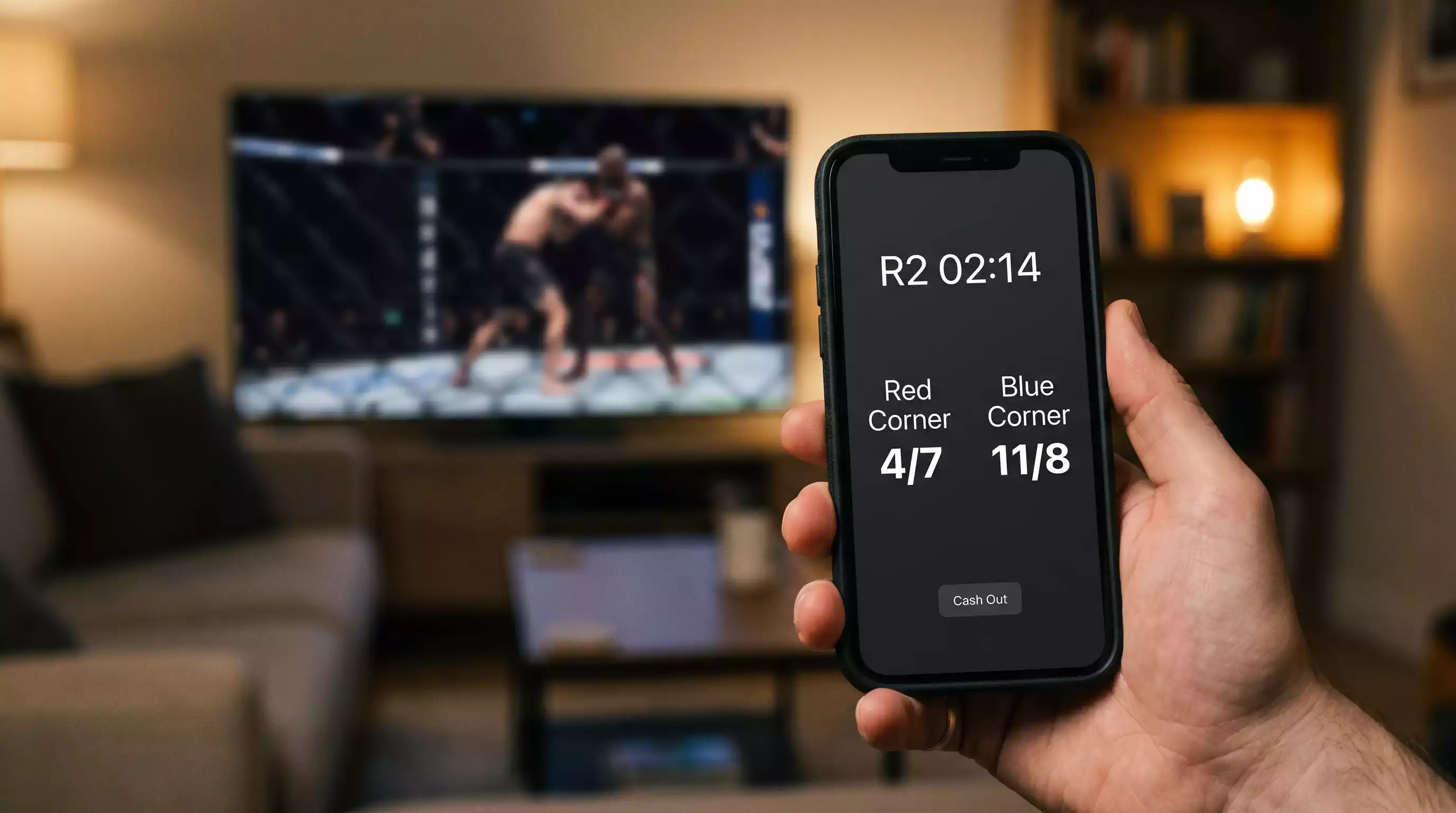
In-Play Markets During The Fight
Live UFC markets typically open between rounds and stay open for a short window before the next round begins, with some operators offering rolling lines during the round itself on a delayed feed. The data confirms how big this has become: UFC accounts for around 11% of all live-bet clicks on the major sportsbooks during event windows. That is a remarkable concentration when you consider how few hours of UFC content air in any given week.
The edge in live betting, when it exists, comes from two places. The operator’s model takes a beat to catch up with what your eyes already saw — a clean knockdown, a heavy first round the price has not yet absorbed. And between-round prices are sometimes set assuming the previous round was closer than it was. The risk is symmetrical: your eyes might be wrong, and live impulse betting is a documented way to chase losses fast. UKGC operators must display affordability prompts on rapid in-play activity, but the prompts are easy to dismiss when adrenaline is high.
Live-betting guardrails — Set a per-fight in-play cap before the first walkout. If you exceed it, the slip closes for the night. The cashout button is not a panic button. If a bet is going wrong, the cashout offer reflects that fact — you are usually buying back disappointment at a premium.
Cashout
Cashout is the live-out feature offered on most UKGC sites, including UFC singles and accumulators. The operator calculates the current value of your slip based on the live moneyline and offers you a number, usually lower than your potential return. Partial cashout lets you take a fraction of that value and let the rest ride.
Worked example: cashout maths on a moneyline
You backed a fighter pre-fight at 2/1 for a £20 stake — potential return £60. Midway through round one your fighter scores a clean knockdown and the live price shortens to 1/3. The operator offers a cashout of £48: the live implied probability multiplied by your potential return, minus a small house cut. Accept the £48, take half (£24 banked, half stake left at the live price), or hold the original ticket. The choice is a function of bankroll, fight read and what you would feel after each outcome.
Live Bet Builder Mid-Fight
The bet builder lets you compose multiple selections inside a single fight: a winner, a method, a round and a prop, bundled into one priced ticket. The operator manually re-prices the bundle to account for correlation. A bet builder of “Fighter A by KO in round 1” plus “fight ends inside the distance” is not the simple product of those two probabilities, because the second is already implied by the first.
Do
- Use bet builder on fights you have actually studied, where you can articulate why each leg makes sense.
- Build legs that tell one coherent story — winner, method, rounds aligned with a single read.
- Keep total bet builder exposure below 15% of your event-night bankroll.
Don’t
- Stack uncorrelated long-shot legs to chase a screenshot-ready price.
- Use bet builder on fights you are watching socially without preparation.
- Treat the bet builder as a guaranteed value because of the headline odds — operator margins on multi-leg builds are wider than on singles.
Integrity Risks In MMA Betting And What They Mean For You
On 1 November 2025, UFC released Isaac Dulgarian after IC360 flagged unusual betting activity around his bout at UFC Vegas 110. Caesars and DraftKings refunded all wagers on the fight. It was the cleanest live-fire example in recent memory of why integrity systems exist, and it should be the first thing on any UK bettor’s mind before they ever stake on a less-televised undercard.
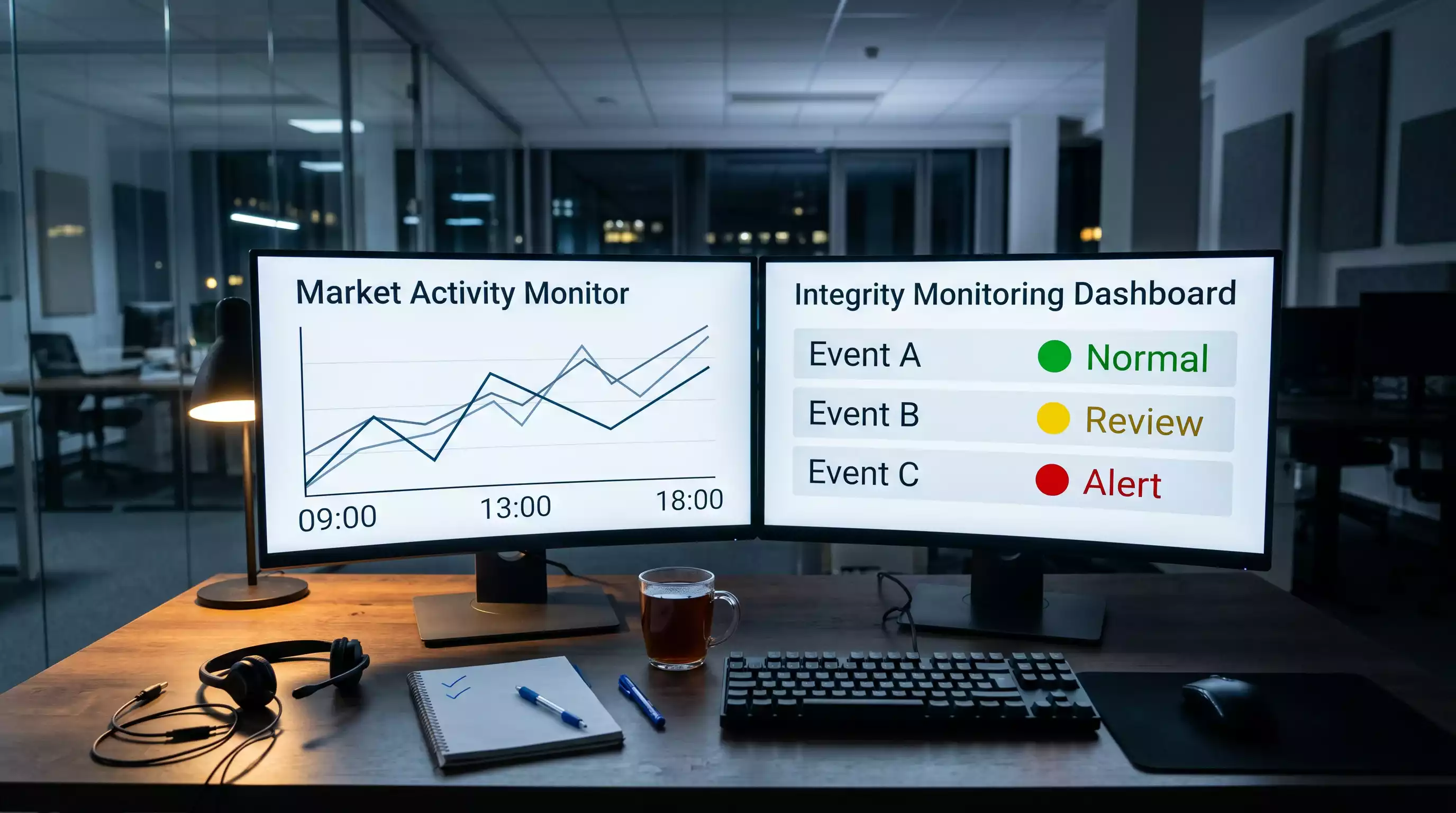
The wider picture from the International Betting Integrity Association is sobering. IBIA recorded 300 alerts of suspicious activity across all sports in 2025, a 29% rise on the 232 in 2024. The same year, the association confirmed corruption in 54 contests, leading to sanctions on 24 athletes and team members across five sports — including one MMA athlete. IBIA’s monitoring net is bigger than most people realise: more than 1.5 million matches across 80 sports, generating around $300bn in annual betting turnover.
Khalid Ali, IBIA’s chief executive, framed the 2025 data plainly: “Our 2025 data highlights a familiar pattern of integrity risk, with football and tennis continuing to account for the largest share of suspicious betting activity. At the same time, the greater scale and reach of our Global Monitoring and Alerting Platform means our ability to detect, assess and support investigations across markets and sports has increased.” The football and tennis lines are the headline, but MMA appearing in the corruption ledger at all is what UFC bettors should sit with.
What IBIA actually does — IBIA pools real-time betting data from licensed operators worldwide. When unusual stake patterns appear on a market — wrong size, wrong timing, wrong directionality versus public sentiment — the system flags the event for joint investigation. Alerts cross operators and jurisdictions in close to real time. IC360, a separate sports-integrity outfit, was the body that raised the flag in the Dulgarian case.
The Dulgarian episode on UFC Vegas 110 in November 2025 produced an immediate UFC contract termination plus full refunds at Caesars and DraftKings. The first time an MMA-specific case moved through the integrity system in public view with a same-week resolution.
Three practical takeaways for the bettor. First, the existence of integrity systems is a reason to stick to UKGC-licensed operators, because they are obliged to report unusual activity and engage with refund mechanisms. Offshore sites have no such requirement and will often void only the suspicious side of a market while keeping unrelated losses. Second, prefer markets with deep visibility: main-card moneylines on televised cards are sampled by more eyes and more models than an obscure prop on a third undercard fight. Third, read the refund policy on your operator before you stake. “Bets stand once the bell sounds” reads differently after a suspicious-activity alert than it does on a quiet Tuesday.
If a price moves dramatically and asymmetrically in the final hours before a fight, especially on an obscure prop in a lower-profile bout, that is a signal worth taking seriously. The sharper conclusion is usually to pass on the market, not to chase the line. Suspicion is information.
The Ten-Minute Routine Before You Confirm A Bet
Most bad UFC bets I have placed share a small set of pre-bet failures. The fight was not studied. The bankroll was not set. The price was checked at one operator and considered “fine.” Over years, those small omissions cost more than any single misread on Saturday night. The routine below is the simplest version of the habit I now follow on every bet, regardless of stake size.
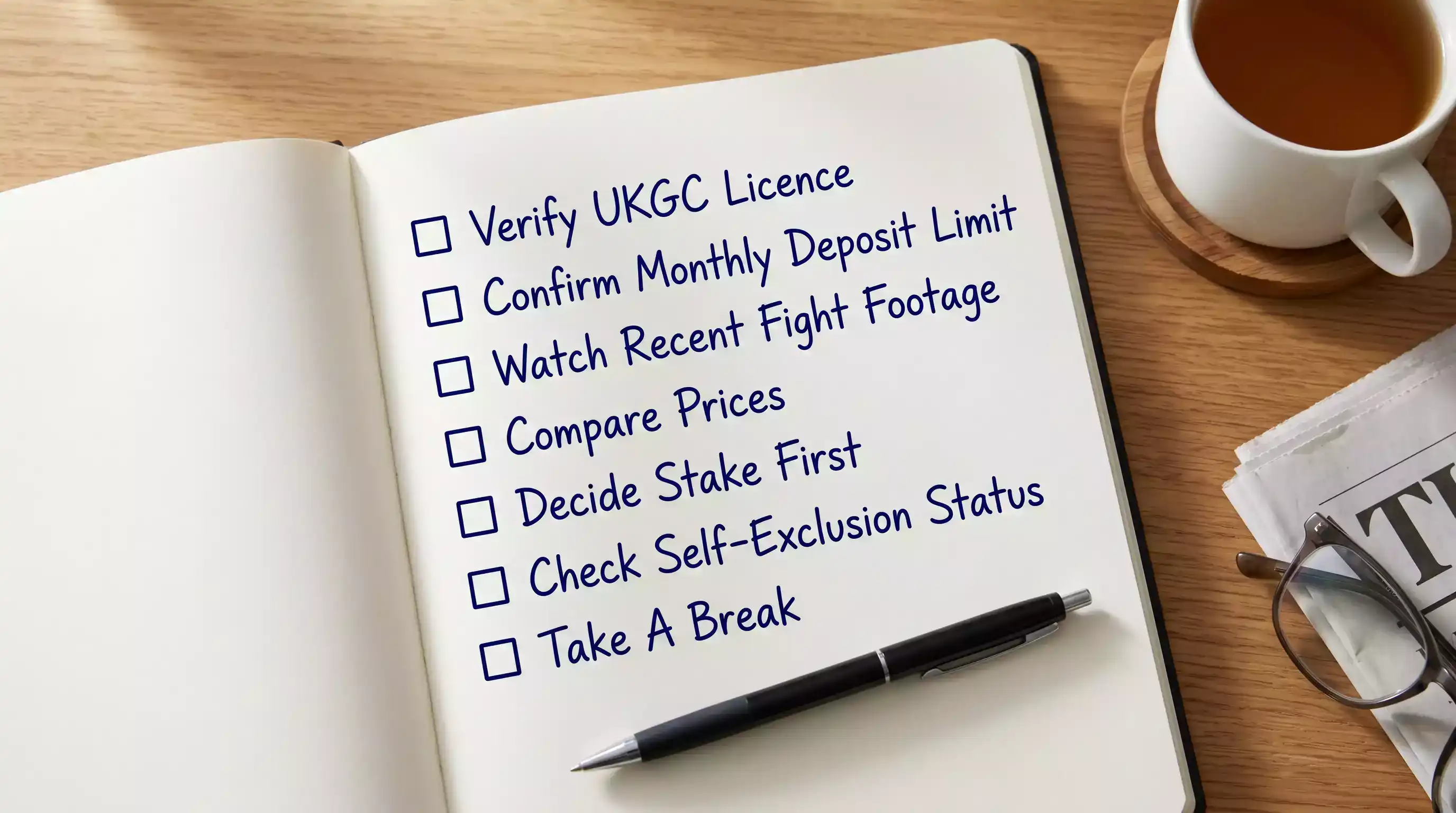
Pre-bet routine for UK UFC bettors
- Confirm the operator’s UKGC licence number against the public register, if it has been more than a quarter since you last checked.
- Set or confirm your monthly deposit limit. If you have already hit it, the bet is closed for the month regardless of the fight.
- Watch at least one full round of recent tape on each fighter, ideally the last loss as well as the last win.
- Note the divisional baseline for the bet type you are placing — finish rate, decision rate, favourite winrate — and compare to the implied probability on offer.
- Shop the price across at least two UKGC operators. A quarter-point on the right side of a 5/2 line accumulates over a year.
- Decide your stake before opening the slip. A stake decided after seeing the price is a stake influenced by the price.
- Confirm your GamStop status reflects your current intention. If you self-excluded and the period is ending, allow the cooling-off to complete in full.
There is a UK-specific context behind the responsible-play points. Across the adult population, 2.7% meet the threshold for severe problem gambling on the PGSI 8+ measure, with another 3.1% at moderate risk. The pattern shifts sharply with age: among 18–24-year-olds, roughly 10% are classified as problem gamblers on the same measure. That younger cohort overlaps heavily with the UFC fan demographic, which is why the pre-bet limit-setting step matters more here than in some other markets. The numbers are not abstract. They are part of the reason the regulator exists.
Do
- Treat your monthly bankroll as a fixed line and stick to it across all operators combined, not per site.
- Bet only on fights you would still want to watch if you had no money on them.
- Take a break between cards. Two events in two weekends is fine; eight events in eight weekends is a pattern worth examining.
Don’t
- Move money to “make a losing week even.” Chasing is the failure mode that produces the worst single decisions.
- Open additional accounts to extract more welcome offers when your deposit limit on the main one is reached.
- Confuse a long winning run with a sustainable edge. Three good weekends do not invalidate a year of careful tracking.
The ten minutes is not a ritual. It is the difference between betting as a hobby with a controlled cost and betting as a habit that quietly grows past the limits you set for it. The bettors I have seen last are not the sharpest predictors. They are the ones who treat the routine as the floor.
The Habits That Keep UK UFC Bettors In The Game
Nine years in, I can tell you that the bettors who last are not the ones with the prettiest predictions. They are the ones who built a routine and refused to abandon it on the nights it felt unnecessary. UFC betting punishes drift quietly. A missed bankroll reset here, a stake decided after the price there, an offshore account opened because the welcome offer “was just better that week” — these are the small choices that compound into bad years.

Stay inside the UK Gambling Commission’s perimeter. The estimated £16.6bn of UK money sitting on offshore sites in 2025 is the largest single warning sign in the industry, and every pound of it is unprotected. Read the line before you read the operator’s marketing. Treat fractional odds as a language you will speak natively, and use the divisional finish-rate baselines as the priors against which every prop bet should be measured. Shop the price. Set the deposit limit. Watch the tape.
The UKGC framework is the closest thing British bettors have to a safety net. The operator’s licence number, your monthly deposit limit and your GamStop status are not bureaucratic items — they are the difference between a sustainable hobby and a leak you will not notice until it has done damage. The data on UK offshore migration is heading the wrong way. Your job is to be in the cohort that does not contribute to it.
If this guide does one thing, let it be the realisation that careful UK UFC bettors are made in the routine, not in the read. The numbers will keep moving — UFC keeps growing, the calendar keeps thickening, the partnerships keep widening — and the long-term winners are the ones who stay disciplined while the noise gets louder. Walk the ten-minute pre-bet routine on every single ticket. Audit your activity once a month. Treat the cashout button as an option, not an exit. That is the habit that keeps you in the game long enough for any actual edge to matter.
Questions UK Readers Send In Most Often
Six questions arrive in my inbox more than any others. The answers below assume you are reading this from Britain and intend to bet through a UK Gambling Commission licensed operator. They are also the answers I would give a friend, which is to say: short, specific and without filler.
Is it legal to bet on UFC fights in the UK?
Yes, provided the operator holds a UK Gambling Commission licence and you are 18 or older. The licence number appears in the website footer and can be verified in the Commission’s public register. Betting through an unlicensed offshore operator is not illegal for you as a customer but strips away every consumer protection — dispute resolution, segregated client funds, GamStop integration and affordability checks. The estimated £16.6bn UK players staked offshore in 2025 sits entirely outside that framework.
What is the minimum age to bet on UFC fights in Britain?
Eighteen, with no exceptions. UK operators must verify your age before accepting a deposit and may request documentary evidence at any stage of the customer relationship. The verification is not optional theatre; it is one of the conditions of the operator’s UKGC licence and a major reason offshore sites with weaker identity checks are not safer alternatives. If a site lets you deposit without any age verification, it is not following UK rules, whatever its homepage claims.
How do UFC betting odds work in the UK by default?
Fractional. The first number is your potential profit per the second number staked: 5/2 means £5 profit per £2 stake; a £20 bet returns £70 total. Every UK operator includes a toggle to switch the entire board to decimal odds (5/2 becomes 3.50, multiplied by stake gives total return). The two formats describe the same price. Implied probability is the bookmaker’s view of likelihood — for 5/2, that is 2 divided by 7, or 28.6%.
Can I bet live on a UFC fight from the UK?
Yes. Most UKGC operators offer in-play markets on the main card and increasingly on prelims. Markets open between rounds and sometimes through them on a delayed feed. UFC accounts for roughly 11% of all live-bet clicks on the major sportsbooks during event windows, so the liquidity is genuine. The cashout feature is available on most live UFC singles and accumulators. Set a per-fight in-play cap before the first walkout — live betting is the format where bankroll discipline matters most.
What is the difference between a UFC PPV card and a Fight Night for bettors?
Numbered Events (the pay-per-view cards numbered UFC 320, UFC 321 and so on) typically run deeper market lists, more prop bets, more bet builder legs and tighter early prices. Fight Nights — including the European-time-zone shows — often launch with thinner lists that thicken in the final 48 hours as more money settles them. The early Fight Night window is sometimes where the price errors live. Live coverage tends to be more sophisticated on Numbered Events; Fight Nights occasionally have slower in-play settlement.
Where do UK viewers watch UFC fights legally in 2026?
UFC’s UK broadcast partner is TNT Sports, which carries the bulk of Fight Nights and selected pay-per-view cards. Paramount+ holds global rights to 13 Numbered Events and 30 Fight Nights as part of the seven-year, $7.7bn deal that took effect this year. Some Numbered Events also remain on traditional pay-per-view through UK operators. Watching the broadcast yourself is a real informational edge: the morning weigh-in visuals, open-workout clips and live announcer reactions all shape the late line moves bettors notice on the slip.
Created by the ”bet on ufc Fight” editorial team.